
Hinge Installation Guide

Cabinet Hinge Installation Guide|Full Overlay, Half Overlay, Inset & 35mm Cup Hinge Selection
International terms × Taiwan field terminology × Installation dimensions × Model reference guide
1. Basic Hinge Terms and Comparison
| Category | English Term | Taiwan Field Term | Key Explanation |
|---|---|---|---|
| Full Overlay | Full Overlay | 6-fen / Straight Arm | The door covers the cabinet side panel edge. Commonly used for single-door cabinets, system furniture, and kitchen cabinets. |
| Half Overlay | Half Overlay | 3-fen / Cranked Arm | Two doors share the same center partition. Each door covers part of the partition. |
| Inset | Inset | Inset / Large Crank | The door sits inside the cabinet frame. It offers a clean flush appearance but requires higher installation accuracy. |
Note: “6-fen”, “3-fen”, and “Inset” are commonly used field terms in Taiwan. For international sourcing and export communication, Full Overlay, Half Overlay, and Inset are recommended. Actual overlay should still be confirmed by C distance, mounting plate height, door thickness, and installation conditions.
2. How to Select a Cabinet Hinge
- Check the door-to-cabinet relationship first: choose Full Overlay when the door covers the side panel; choose Half Overlay when two doors share one partition; choose Inset when the door is installed inside the cabinet frame.
- Check the application environment: standard indoor furniture may use conventional plated steel hinges. For kitchens, bathrooms, coastal areas, high-humidity environments, or greasy conditions, SUS304 stainless steel or corrosion-resistant configurations are recommended.
- Check functional requirements: choose Soft-Close for quiet closing. Choose Clip-on / quick-release hinges when frequent door removal, maintenance, or cleaning is required.
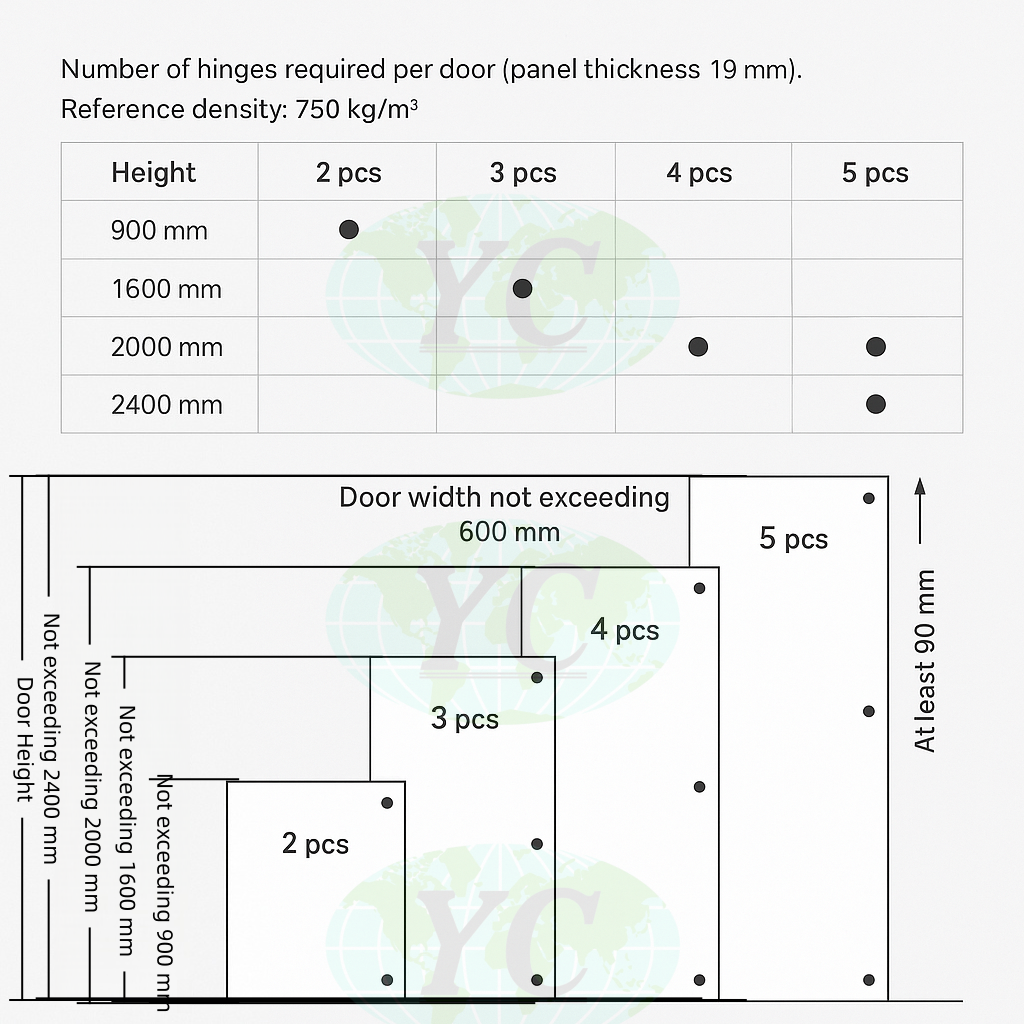
- Check door weight and usage frequency: for taller, wider, heavier, or frequently used doors, increase the number of hinges and consider four-hole mounting plates, wing mounting plates, or stronger fixing structures.
3. Opening Angle and Tolerance: Opening Angle ≠ Clip-on
- Opening angle is the geometric specification of the hinge, such as 90°, 105°, 155°, or 165°. Actual on-site angle may vary slightly due to door thickness, C distance, mounting plate height, board tolerance, handle position, and installation accuracy.
- Clip-on / quick-release refers to the way the door can be attached or removed. It does not mean the opening angle is larger, and it does not automatically solve all wide-opening applications.
- If the door hits the wall, handle, pull-out basket, or drawer, first check the C distance, mounting plate position, mounting plate height, and door gap before deciding whether a 155° or 165° wide-angle hinge is required.
- Common applications: standard cabinets often use hinges around 90° to 110°. For corner cabinets, pull-out baskets, deep cabinets, or wider access space, 155° or 165° hinges may be considered.
4. Door Boring and Design Dimensions
| Item | Common Reference Value | Explanation |
|---|---|---|
| Cup Diameter | φ35 mm is the mainstream size Some series offer φ26 mm or φ40 mm |
φ35 mm is the most common size for concealed hinges. φ26 mm is often used for smaller doors, while φ40 mm may be used for thicker, larger, or heavier doors depending on the model. |
| Cup Depth | Standard hinge cup: approx. 11–12 mm Shallow cup such as H1235: approx. 9.5 mm |
Cup depth must match hinge cup height, door thickness, and jig setting. A shallow cup is used when cup depth is limited; it does not mean the cup diameter is smaller. |
| C Distance | Commonly approx. 3–6 mm | C distance affects overlay, door gap, and movement clearance. Too large or too small a value may cause poor gaps, interference, or unsmooth closing. |
| Applicable Door Thickness | Commonly approx. 14–22 mm | Applicable door thickness varies by model. Thin doors, thick doors, heavy doors, and glass doors must be checked separately. Cup diameter alone is not enough for selection. |
| Door Gap | Commonly approx. 1.5–2.0 mm | Allow space for coating, veneer, board movement, and installation tolerance to prevent scraping, rebound, or poor closing. |
Reminder: The above values are general engineering references. Final confirmation should be based on product samples, official drawings, jig settings, door material, door weight, and on-site structure testing.
5. Standard Installation Steps
- Confirm the door type: identify whether it is Full Overlay, Half Overlay, or Inset. Confirm door thickness, weight, height, width, and the expected number of hinges.
- Mark the position: confirm C distance, hinge cup location, mounting plate height, and designed door gap.
- Bore the hinge cup hole: use a suitable boring jig. φ35 mm is the common size. Set the depth according to the hinge cup specification to avoid boring through the door.
- Install the hinge cup: insert the hinge cup into the bored hole, confirm proper seating, and fasten it with screws.
- Fix the mounting plate: select a two-hole plate, four-hole plate, wing plate, or clip-on mounting plate according to the model and cabinet structure.
- Hang the door and adjust: use three-way adjustment screws to align the front-back position, left-right gap, and up-down height.
- Function test: open and close the door multiple times to check for noise, rebound, scraping, wall impact, handle interference, or pull-out basket interference. If issues occur, recheck the C distance, plate position, and stopper design.
6. Material and Surface Finish
| Item | Option / Export Description | Application |
|---|---|---|
| Standard Material | Steel body with anti-rust plating or common nickel-plated finish | General furniture, wardrobes, system cabinets, office cabinets, and indoor cabinet applications. |
| SUS304 Stainless Steel | 304 stainless steel material, can be paired with stainless steel screws and soft-close structures | Kitchens, bathrooms, coastal areas, high-humidity environments, greasy conditions, medical equipment, laboratories, or applications requiring higher corrosion resistance. |
| Surface Finish | Commonly nickel plated or stainless steel original finish. Other colors depend on project requirements. | If salt spray testing, color tone, coating thickness, or corrosion resistance standards are required, acceptance criteria should be defined before inquiry and order confirmation. |
7. Frequently Asked Questions
Should the hinge cup or mounting plate be installed first?
What should I do if the door hits the wall, handle, or pull-out basket?
How can I quickly identify Full Overlay, Half Overlay, and Inset?
Can hinges and mounting plates from different series be mixed?
What is the difference between Soft-Close, Clip-on, and Wide-Angle?
8. Model Reference Guide
This reference table helps installers, designers, and purchasing teams quickly match hinge specifications. Complete model availability, dimensions, and supply status should still be confirmed by product pages, physical samples, or official drawings.
| Model | Specification / Positioning | Application Notes |
|---|---|---|
| A. Standard Concealed Hinge Platform(φ26 / φ35 / φ40; φ35 is the mainstream size) | ||
| H1066 / H1066SC TC / EN |
φ26 / φ35 / φ40|approx. 90–100°|standard / soft-close version | H1066 is the standard version, while H1066SC is the hydraulic soft-close version. φ35 is the mainstream size; φ26 is suitable for smaller doors, and φ40 may be used for thicker, larger, or heavier doors. |
| H1221 TC / EN |
90° concealed hinge | Independent hinge system. Its appearance, arm shape, and mounting plate design differ from the H1066 platform. Sample installation is recommended before substitution. |
| B. Shallow Cup Hinge(limited cup depth; still φ35, but shallower cup) | ||
| H1235 / H1235SC TC / EN |
φ35|9.5 mm cup depth|90°|standard / soft-close version | Suitable for thin doors or doors with limited boring depth due to rear grooves, shapes, or structural restrictions. For thin system furniture panels, door thickness around ≤16 mm may be considered first. |
| C. 105° Soft-Close Hinge(American-style / standard cabinet application) | ||
| H1237SC TC / EN |
φ35|105°|approx. 11.5 mm cup depth|applicable door thickness approx. 14–22 mm | Suitable for cabinets requiring a 105° opening angle and soft-close function. Overlay, C distance, mounting plate design, and door thickness should be checked before use. |
| D. 155° Wide-Angle Soft-Close Hinge(wide opening / pull-out basket / corner cabinet) | ||
| H1252SC TC / EN |
φ35|approx. 155°|two-stage soft-close|wing mounting plate|Clip-on quick-release|recommended door thickness approx. 16–22 mm | Suitable for corner cabinets, deep cabinets, pull-out basket cabinets, double-door cabinets, large doors, or applications requiring wider access. Includes both soft-close and quick-release features. |
| E. 165° Wide-Angle Hinge(corner cabinet / large cabinet door / full access requirement) | ||
| H1241SC TC / EN |
φ35|165°|four-hole clip-on mounting plate|hydraulic soft-close|straight arm / cranked arm / inset arm | Combines wide-angle opening, soft-close, and clip-on quick-release functions. Suitable for cabinets requiring wide access, quiet closing, and quick door removal. |
| H1230 TC / EN |
φ35|165°|fixed four-hole mounting plate|non-soft-close|non-clip-on | Suitable for applications requiring a 165° opening angle without soft-close or quick-release function. Stable structure for fixed installation use. |
| H1228 TC / EN |
φ35|165°|inset arm|raised mounting plate H=9|fixed two-hole plate|non-soft-close|non-clip-on | Used for inset or structures requiring extra clearance. Actual use should be confirmed by door thickness, C distance, mounting plate position, and interference conditions. |
| F. SUS304 Stainless Steel Soft-Close Hinge(humidity / coastal area / kitchen & bathroom / high corrosion resistance) | ||
| H1242SC TC / EN |
φ35|304 stainless steel|four-hole mounting plate|wing plate / square plate|clip-on quick-release|Soft-Close | Suitable for kitchens, bathrooms, coastal areas, high-humidity environments, greasy conditions, medical equipment, outdoor cabinets, and laboratory cabinets requiring higher corrosion resistance. |
| G. Glass Door Hinge(non-φ35 cup hinge system) | ||
| H1226SC TC / EN |
Rectangular glass door hinge|W26|nickel-like finish | Dedicated glass door hinge, not a φ35 concealed cup hinge system. Fixing method, glass thickness, and gasket configuration should be confirmed by sample or drawing. |
| H. Exposed Hinge(non-concealed hinge / no φ35 cup boring) | ||
| H1212 / H1212SC TC / EN |
90° exposed hinge | Traditional exposed hinge, not a concealed cup hinge system. Suitable when an exposed hinge appearance, special door type, or specific structure is required. |

